Headline result: Clinical prediction and privacy-preserving collaboration
Critical care patients are among the most vulnerable — yet managing their nutrition, predicting complications, and coordinating care remains largely manual. We build machine learning systems that turn ICU data into actionable clinical decisions, improving patient outcomes through real-time prediction.
Research Areas
- ICU Nutrition & Feeding Complications — Models trained on a decade of records from Rabin Medical Center that predict feeding intolerance and caloric deficit before symptoms appear, optimizing enteral nutrition per patient.
- Rare Respiratory Disease Phenotyping — Unsupervised clustering and AI phenotypical analysis for NTM lung infections, accelerating diagnosis and predicting treatment response in pulmonology.
- Privacy-Preserving Medical Data Collaboration — Federated learning and crowdsourcing frameworks enabling multi-hospital research without exposing patient records.
Technical Methods
Our pipeline combines gradient-boosted trees and deep learning for tabular clinical data, time-series models for continuous monitoring streams, and survival analysis for time-to-event outcomes. All models are validated prospectively against held-out hospital cohorts before clinical reporting.


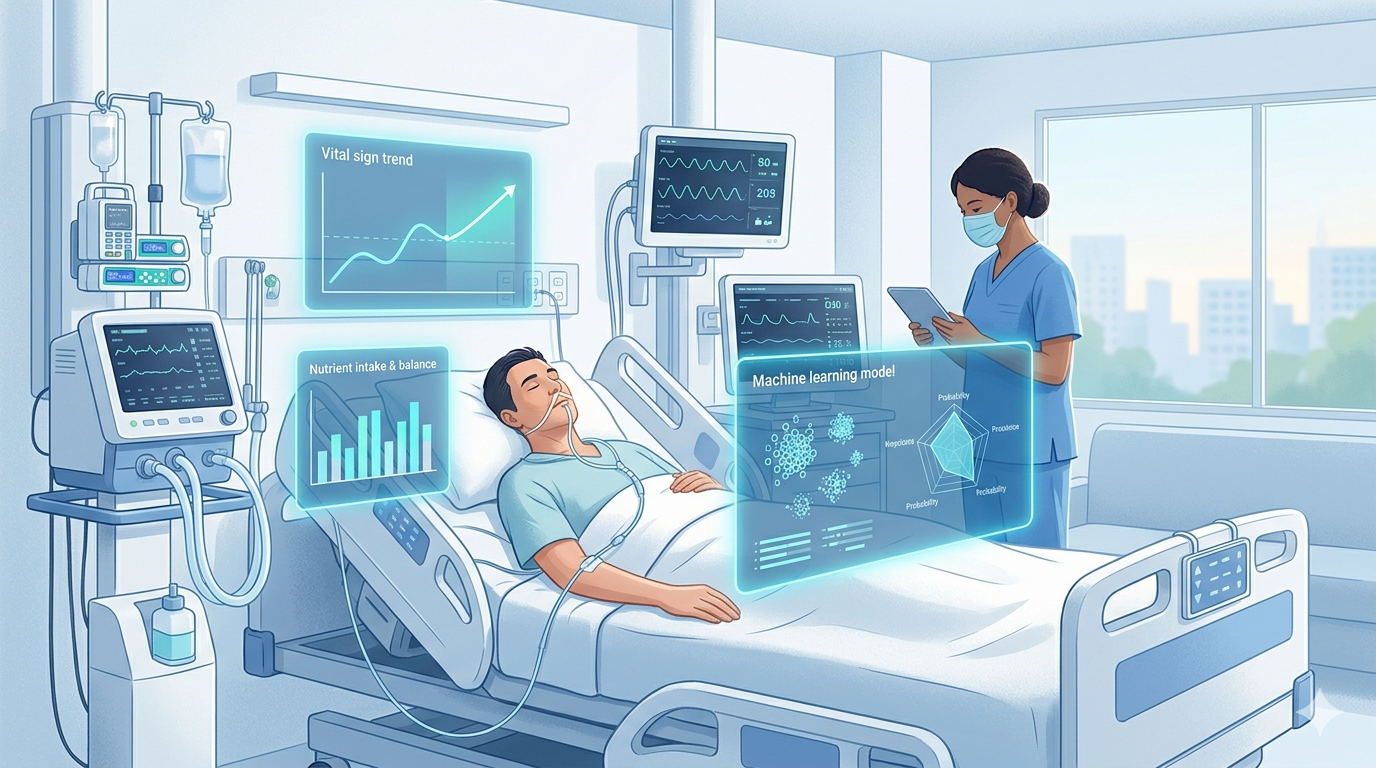
Left: Real-time patient monitoring generating continuous data streams. Middle: Critical care enteral nutrition delivery. Right: AI-driven analysis of complex clinical data patterns.
Key publications & resources
- Publications — filter by the Healthcare topic to see this project's papers.
- Code & software — lab repositories, datasets, and tools.
Collaborate with us
We welcome academic and industry collaborations, and motivated graduate students, on this research line. Get in touch →